


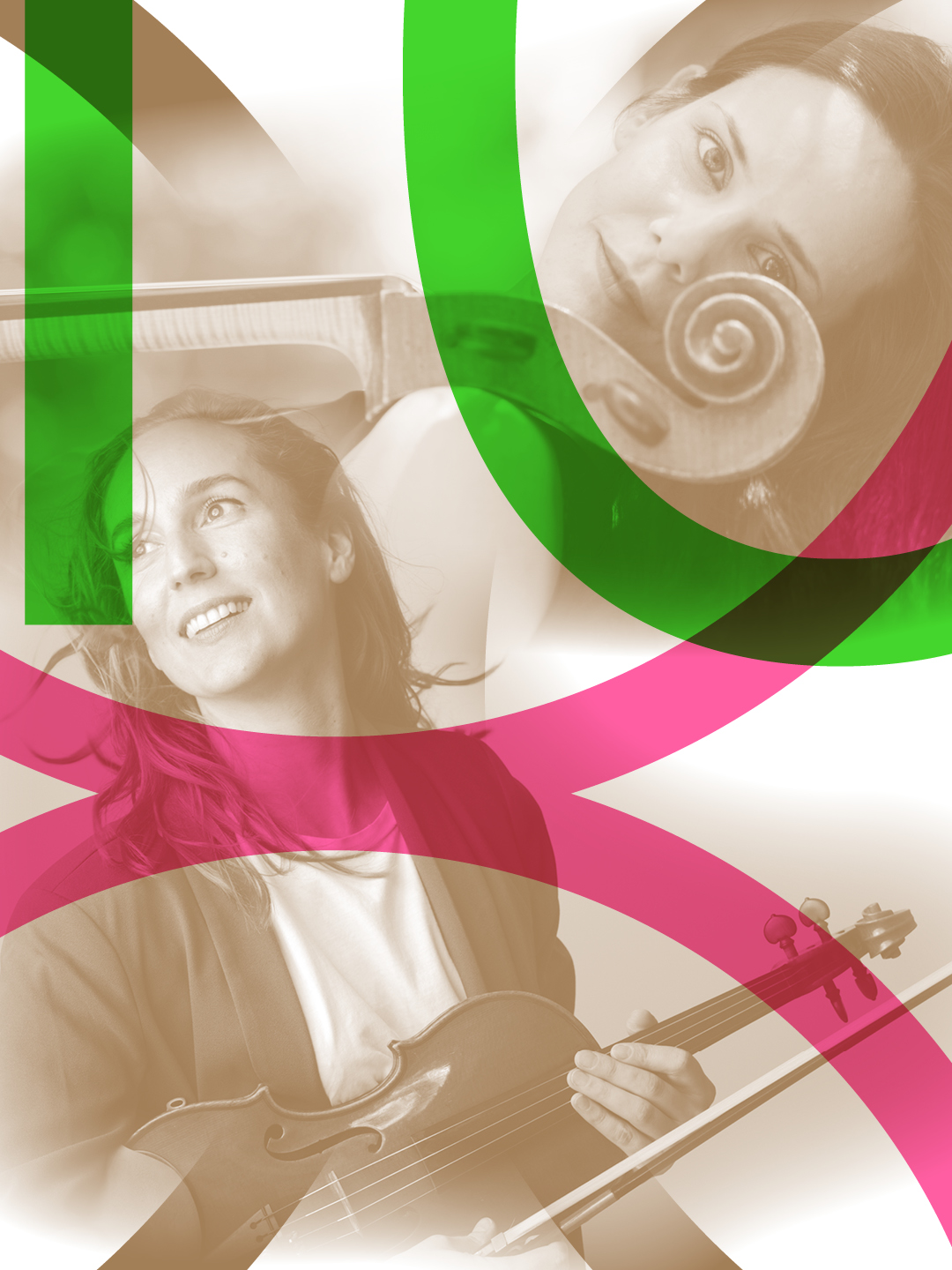
Roots & Revolutions. From Bach to Stravinsky
Maria Anissegou, Olga Holdorff Myriangou
Wed, 26 Aug, 21:00
Karavas Estate (Karaviko), Kampos
The “Roots and Revolutions” concert traces the evolution of European music from the solid foundations of the Baroque tradition to the radical explorations of the 20th century. The violin and cello engage in a constant dialogue through the works of composers such as Bach, Haydn, Beethoven, Glière, Bartók and Stravinsky, highlighting the continuity and transformation of musical language over the centuries.
From the clarity of counterpoint and classical balance to the romantic expressiveness, folk tones and the bold rhythmic and harmonic innovations of modernism, this programme showcases the various manifestations of a shared artistic legacy. Every piece of work is part of a chain of creative inspiration, in which tradition is not static but constantly transformed into something new.
A musical journey full of contrasts and connections, where the “roots” of the past converge with the “twists” that have shaped the future of Western music.
Cellist Maria Anissegou studied at the State Conservatory of Thessaloniki, and the Higher Music Schools of Würzburg and Leipzig on scholarships from the State Scholarship Foundation (IKY) and the Friends of Music Society. She has performed as a soloist at major festivals in Greece and abroad, and is a member of the IAMA Trio and the VersUs Ensemble. She is also a permanent member of the Thessaloniki State Symphony Orchestra and teaches at the New Conservatory of Music of Thessaloniki.
Violinist Olga Holdorff Myriangou has collaborated with some of Germany’s leading orchestras and ensembles, and has performed in Europe, Asia, Canada and the Middle East. She is a member of Lux:NM and the founder of the Berlin Music Ensemble, as well as one of the two artistic directors and co-founder of the Chios Music Festival. She has collaborated with leading orchestras such as the Berliner Philharmoniker, the NDR Elbphilharmonie and the WDR. She has also taught at the Barenboim-Said Foundation in Palestine and the “El Sistema” programme in Venezuela.
Performed by: Olga Holdorff Myriangou (violin), Maria Anissegou (cello)
Programme
Johann Sebastian Bach (1685-1750)
Inventions No. 1, No. 4, No. 8 for violin and cello
Joseph Haydn (1732-1809)
String duet in D major for violin and cello
Igor Stravinsky (1882-1971)
Suite Italienne – Serenata (arr. for violin and cello: Gregor Piatigorsky)
Eleftherios Veniadis
A summer’s day in Chios in the 1980s
Ludwig van Beethoven (1770-1827)
String duet in C major No. 1 for violin and cello
Reinhold Glière (1875-1956)
Eight pieces for violin and cello, Op. 39
Béla Bartók (1881-1945)
Six Romanian folk dances for violin and cello
Johann Sebastian Bach (1685-1750)
Inventions No. 1, No. 4, No. 8 for violin and cello
Thanks to its high pedagogical value, the music of J. S. Bach for keyboard instruments became the focus of the musical world. Almost every step of today’s piano students’ progress involves encountering his compositions. In these two-part Inventions, J. S. Bach makes sure to gradually familiarise the performer both with the contrapuntal techniques of the canon and the fugue, as well as with the more homophonic and ornate style of writing for a single melodic voice and accompaniment.
For the same reasons, they are interpreted just as superbly by a string duo, with the violin and cello being the ideal combination. In Invention No. 1 the violin and the cello play equal parts in an ongoing and lively dialogue with the main melody. In Invention No. 4 we can sense the energy of a fast, whirling dance in 3/8 time. Finally, in Invention No. 8, one of the most recognisable, cheerful and technically demanding Inventions, a sense of constant movement prevails.
Joseph Haydn (1732-1809)
String duet in D major for violin and cello
Joseph Haydn elevated chamber music from a simple form of home entertainment to one of the most serious and refined art forms. He established an equal dialogue between the instruments, with the melodic line constantly transferring from one instrument to another. His sense of humour and love of teasing often shine through in his musical compositions. The duet for violin and cello included in the programme is a beautiful piece of chamber music that showcases the composer’s wit. The first publication was in London around 1781 by William Forster.
Throughout the piece, the violin and cello share the same melodies, conversing with a particular sense of humour. The piece opens with a slow movement that leads into the second movement, a minuet –a well-known Baroque dance form. However, this minuet is unusual for this period because it is based on the “theme and variations” structure. The third movement is fast and lively, bringing this charming piece to a close on an optimistic note.
Igor Stravinsky (1882-1971)
(arr. for violin and cello: Gregor Piatigorsky)
Suite Italienne
Serenata
Following the First World War and the Russian Revolution, the Russian composer Igor Stravinsky settled permanently in France. Cut off from his homeland, he seeks inspiration in the history of Western Europe. The famous ballet Pulcinella (1920) marks a turning point in the composer’s career, combining the rhythms and harmonies of 20th-century music with authentic Italian Baroque melodies (and more). Serenata is the second movement of the Suite Italienne, which is based on music from the ballet Pulcinella. In the original version, it is a tender, mournful tenor aria.
This deeply expressive transcription for cello and piano was created by the composer himself in close collaboration with the renowned cellist Gregor Piatigorsky in 1932. Shortly afterwards, Piatigorsky transcribed the suite for other string combinations, including the enchanting version for violin and cello. This transcription was originally intended for performance by two legendary 20th-century virtuoso musicians: the violinist Jascha Heifetz and the cellist Gregor Piatigorsky.
Eleftherios Veniadis
A summer’s day in Chios in the 1980s
Through his music, Eleftherios Veniadis reminds us of carefree Chian summers in the 1980s: warm, bright and full of childhood innocence. Moments of reminiscence and nostalgia that bring back distant eras, eras inextricably linked to our fondest childhood memories. The composer’s work takes us on a journey into the past, evoking the sweetest recollections of that time.
Ludwig van Beethoven (1770-1827)
String duet in C major No. 1 for violin and cello
The first of the three duets (WoO 27) by Ludwig van Beethoven is an enchanting piece of chamber music from the composer’s early creative years. Although it was originally written for clarinet and bassoon in Bonn, it is now more often performed by string instruments, mainly in a transcription for violin and cello. Although he composed it at a young age, the duet highlights the composer’s ever-evolving mastery of thematic development, as well as his ingenious ability to balance the timbres between the two instruments. The original manuscripts were lost, and the music was only published after his death.
Allegro comodo is a bright and energetic movement characterised by a constant dialogue and alternation of melodic lines between the two instruments. The Larghetto Sostenuto is antithetical in its first part, elaborating on a lyrical and strongly expressive melody. As expected for the period, Rondo. Allegretto is a playful, fast-paced and lively finale that keeps performers and audiences on their toes.
Reinhold Glière (1875-1956)
Eight pieces for violin and cello, Op. 39
Reinhold Glière (of German and Ukrainian descent) was a composer of the Russian Empire and the Soviet Union. The “Eight pieces for violin and cello” is one of the most popular duets in the world of chamber music. They are dedicated to the violinist Boris Kaliusno and date back to 1909. That is to say, they were written after Glière returned from Berlin and during his time as a professor at the Gnesin Institute.
At the time of composing the duets, his professional career, as well as the title of the 8th track, “Etude”, may give the impression that these are instructional works. However, from the very first notes, it is clear that executing the piece requires musical maturity and perfect synchronisation. This work characteristically combines the late romantic tradition with excellent string technique and highlights the composer’s virtuosity in small forms. The Prelude is lyrical and expressive, marking the beginning of a dialogue between the two instruments. In contrast, the Etude finale is virtuosic and dynamic, requiring great technical precision from both performers.
Béla Bartók (1881-1945)
Six Romanian folk dances for violin and cello
During the First World War, the Hungarian composer and ethnomusicologist Béla Bartók wrote in a letter: “I consider it my life’s goal to continue the study of Romanian folk music in Transylvania to the end”. The “Six Romanian Folk Dances” is one of his most popular works, based on traditional Transylvanian melodies which he recorded while working as an ethnomusicologist. Although they were originally written in 1915 for solo piano and later for chamber orchestra, this arrangement for violin and cello uniquely highlights the traditional sound of stringed instruments from the region.
The first dance is performed by a young man with a stick. It involves intricate steps and ends with a jump so high that the dancer can kick the low ceiling, as Bartók notes. The second is a circular and fast dance. The name of the third dance refers to the choreography, as a pair of dancers step in the same spot. The fourth dance comes from the Romanian village of Bucium. The composer heard this melancholy tune in 3/4 time being played on the violin by a Gypsy. Rhythmically speaking, the Romanian polka that follows is the most interesting piece in the cycle thanks to the constant alternation between 2/4 and 3/4 time. The cycle concludes with an energetic, whirlwind dance that leads to an explosive finale.